
Katherine Steichen Rosing
Harbingers
Description
Your Subtitle Goes Here
Harbingers is an immersive installation of tattered fiber columns pierced by flame, suggesting a ghost forest in the aftermath of wildfire. Dozens of these forms are suspended from the ceiling with paths through the installation inviting viewers to contemplate the impact of extreme weather patterns amplified by the climate crisis. Drought and the fires that follow impact not only forests, but human survival. The tree- like cylinders are made from stark white linen gauze, painted with India ink, and burned and charred with a candle. Working with flame was an intense observation of the impact of oxygen, fuel, and wind gusts; and at the same time, a meditation on wildfire and the carbon released by these fires. On days when red flag warnings for extreme drought and wind were issued in Madison, Wisconsin, where she lives, she paused the burning.
White symbolizes the draining of life, and its absence; India ink, made of burnt particulates, symbolizes the aftermath of fire and perhaps the remnants of life. Rosing began this work long before the fires began this summer in the Boundary Waters and Quetico Provincial Park. These are Lake Superior wilderness areas where she canoed,
camped, and hiked as a child over 50 years ago and returned to with her sons decades later.
Inhale/Exhale, Until the Last Breath, the video projection, begins as a quiet hike through thriving forests past quiet ponds teeming with life. Juxtaposing euphoria and peace experienced in wild spaces with climate anxiety, signs of fire emerge along with other imagery visualizing the atmosphere in transition, filling and thickening with carbon.
Rosing’s small paintings allude to the aftermath of wildfire and to the spirits of trees lost. We have looked for forests to save us from the climate crisis. Will they survive — and how much is their distress adding to atmospheric carbon?
About the Artist
Your Subtitle Goes Here
Katherine Steichen Rosing (b. Appleton, WI) envisions the invisible forces connecting forests and watersheds to atmosphere and climate processes through abstract-symbolic paintings and immersive installations.
Her work has been exhibited in over 100 solo and group exhibitions in galleries and museums internationally, including Hillyer Gallery (Washington, D.C.), Tomioka Museum (Tokyo), Saitama Modern Art Museum (Saitama, Japan), The Rockford Art Museum, The Museum of Wisconsin Art, ARC Gallery (Chicago), Amos Eno Gallery (NYC), and Kim Storage Gallery (Milwaukee).
She has been awarded science-based artist residencies at the UW-Madison Department of Limnology’s Trout Lake Research Station and the St. Croix Watershed Research Station (Science Museum of Minnesota), and a residency at Pouch Cove Foundation in Newfoundland, as well as grants including the 2022 Forward Art Prize and the Madison Arts Commission/Wisconsin Arts Board Individual Artist Fellowship.
Rosing’s work is held in public and private collections internationally including Northwestern Mutual, Science Museum of Minnesota, and University of Wisconsin Collection. She is represented by Kim Storage Gallery in Milwaukee, and Groveland Gallery in Minneapolis. Rosing earned an MFA in painting and drawing from Northern Illinois University and lives and works in Madison, Wisconsin.
Artist Statement
Your Subtitle Goes Here
I make paintings and immersive installations informed by experiences in the wilderness and research. Forests are my lens to climate, atmosphere, and the carbon and water cycles. Saturated color in the abstract symbolic paintings expresses the tension between ecological grief and sheer joy in their beauty, while the more somber tone of the monochrome installations articulates the anxiety I feel about the climate crisis.
Towering sculptures made of delicate fibers create spaces for viewers to experience the threats facing forest ecosystems. I use techniques like burning and charring with a candle, staining with India ink, cyanotype, and embroidery on linen and cotton gauze. In my installations, black symbolizes carbon and life, while white denotes the absence of life.
My paintings incorporate root-like lines drawn into the paint referencing unseen ecological connections and microscopic life. These marks are often buried beneath densely layered color and surface, like fragile, hidden ecological processes.
Public Programs
Your Subtitle Goes Here
First Saturday
Saturday, October 3, 2026, 1 to 1:45 p.m.
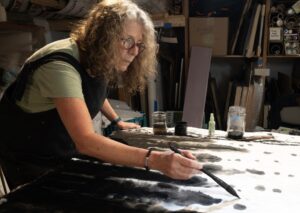
Guided Tour by Katherine Rosing
Join our featured solo artist, Katherine Rosing, who will guide visitors through her installation titled Harbingers. Designed as an immersive, multimedia installation, Rosing’s exhibition resembles a ghost forest in the aftermath of a wildfire.
Free to the public (a donation of $10 is suggested)