SEARCH FOR CONTEMPORARY IDENTITY: CONALL CARY

Your artist’s statement discusses a recent focus on the damage outdated conceptions of “masculinity” can have on contemporary young men. Does the theme of inherited identity present in this new focus have a connection to the exhibition on Irish identity? Why or why not?

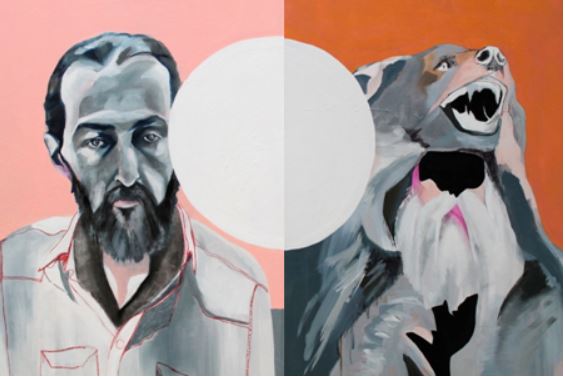
In Ireland I think that traditional masculinity and traditional ‘Irishness’ both have roots in similar environments, such as The Church and a largely working class industrial and agricultural population. Both are transitioning to a world that is radically different, with a shift away from The Church and the diversification of the workforce to the I.T. sector and cities/urban development.

As such in many ways I think my work for this exhibition can be a commentary on both a ‘masculine’ or an ‘Irish’ search for contemporary identity.

What liberties and limitations does printmaking as a medium allow?

I often say that if I was allowed to make the piece that I initially had in my head it would always be worse than the piece that I end up making, and part of this is because the process of making a print puts its direction on the works regardless of the intentions of the artist, and to me I find this is what allows for an element of surprise and newness to emerge.

For me it is the ‘limitations’ of print that force me to be freer with the work, to let the forces of chance at work within a structured environment.

CONNECTING PHYSICALLY AND PSYCHOLOGICALLY: Q&A WITH JACKIE HOYSTED

Jackie is the curator of June 2016 exhibition “Repression, Resurgence, Reemergence,” and the head of Visual Arts Programming for Solas Nua.


As the Director of Visual Arts for Solas Nua, the only non-profit organization in the United States dedicated to contemporary Irish arts, what is the most rewarding aspect of your position?

I really enjoy seeking out Irish artists and becoming familiar with their work and processes. It is very rewarding to be able to connect with them and create opportunities to showcase their work here in the US.  I think there is a great community of visual artists, creating really good work in Ireland and it makes me very proud to showcase it here.

Within your bio, it is stated that you are a native of Ireland and currently reside locally, in Maryland. How have your personal experiences with Irish identity impacted the process of putting together “Repression, Resurgence, Reemergence”?

Pulling together the show really made me think hard about who is Irish and that is reflected in the artists I selected to participate in the show.  I’ve been living in the US for twenty years now and and prior to that I lived in the UK and France but I still think of myself very much as Irish, even though here is my home now. So the mix of participants in the show comprises a selection of artists born and still living in Ireland; artists who have emigrated there and who have made it their home plus people like me who emigrated but has strong ties to Ireland and also some generational Irish-Americans who maintain strong cultural connections.

While curating this exhibition, were there any emotions or messages in the artwork or in your reception of pieces that surprised or challenged you?

I connected with all of the work at some level as each artist’s work spoke to me in different ways. I relate strongly to Helen O’Leary’s work which is about “making do” – I came from a relatively poor household so there was never any such thing as buying something , or wanting or getting. You just made do or made it yourself. I also particularly connected with Vanessa Donoso Lopez’s beautiful drawings. Vanessa is a Catalan artist living in Dublin and her work speaks about being an emigrant and living life through a second language. Some of her drawings show her moving with all her possessions  and it reminds me of how many times I moved homes as I moved to and from different countries. It seemed that my moving boxes were almost more important than my possessions.  She also talks about a living “diluted” life because she has to communicate through a second language and wonders what she misses out on by not understanding subtleties. Her experience reminds me of the years I lived in France and how I struggled communicating in another language.

Many of your own pieces include interactive elements. This exhibition consists of visual arts of many different forms. Due to the highly personal yet collective nature of the subject, personal national identity, do you view this exhibition as a different form of “interaction”? Why or why not?

I hadn’t thought of this but I definitely wanted the gallery audience to connect physically and psychologically with the work – whether that is peering at smaller work to discover what is really going on, standing back to take in a larger work, putting on headphones to be quiet and listen to sound of voices reading different text or staring looking at a video and wonder what is going on. Hopefully by having different experiences with each artwork, it encourages the viewer to wonder and ask more about what is behind the works.

SPONTANEITY OVER PRECISION: Q&A WITH DOMINIE NASH

What inspired you to experiment with the process of printmaking? Who is your favorite printmaking artist?

It happened sort of by accident many years ago. I had been dyeing fabric and yarn, and a friend suggested we try to do batik. We got some books and muddled along until we figured it out. Eventually I got tired of dealing with the wax, but by then was hooked on putting images on cloth and continued to learn a variety of processes. It is still my favorite part of my practice, though I have a long way to go to be a proper printmaker.

I am lucky to have had the opportunity to learn from and to work in close contact with some wonderful printmakers: Nancy McNamara,Aline Feldman, Julio Valdez, and the members past and present of the Graphics Workshop— and too many others to mention. I am also inspired by the prints of Jasper Johns and Helen Frankenthaler

Can you talk more about the process of monoprinting, and what it has added to your work?

Since I am more interested in  spontaneity than precision, and do not need to produce editions, monoprinting is perfect for my needs and is very adaptable to working on fabric. The variation in each print pleases me, and so does reworking or overprinting. I have done simple monoprinting by inking a plate and marking marks in the ink, made collagraph plates and gelatin plates, and use a kind of monoprint technique on  a screen with dyes, in which each subsequent print becomes unique as the dye is gradually used up.

My work is basically collage, with the printed fabrics becoming the elements of the collage. They add so much texture and depth to my work that I can’t imagine creating my work without printing.

What effect do you believe viewing many different techniques and approaches in one gallery will have on the viewer?

The print processes  I use vary in the way they convey the essence of the image I want to portray: crisp, soft, blurry,rough, etc, each process giving a particular effect. My work always involves layers, or the illusion of layers. I hope the variety of print processes and stitching will help the  viewer to look beneath the surface to find these layers. I’d like it to be a process of exploration and discovery.

In your bio, you state “since I didn’t know the rules, I was free to break them and to achieve the kind of spontaneity I was seeking.” Do you advise for young artists to take a similar approach?

Well, it works for me. Everyone needs to learn some technique in their chosen medium, and you can save a lot of time by gathering information from  books, classes, or other artists—I unashamedly pick people’s brains, always hoping to return the favor. However, so much can be learned by just trying and experimenting, and using the resulting mistakes and accidents (which will certainly happen) as opportunities to gain new insights and directions. Stay away from words like “should” or ‘can’t”

CONCEPTUAL CHARACTER: Q&A WITH SASCHA HUGHES-CALEY

As a multimedia artist, with the No Joke installation at Hillyer featuring performance documentation, sculpture, and video work, how do you ensure unity in your pieces?

I trust that formal and conceptual unity will be there. It is important for me to see how each piece works in conversation with the other. For No Joke, I had to privilege the unity of each individual work and trust that a larger conceptual unity would be present in its installation.

The show really centers around two fictional characters (performance documentation and various monuments to each) as well as a video installation.

What inspired No Joke’s focus on cultural miscommunication as a critique of the American wellness market? What thoughts do you hope to inspire in viewers?

During two visits to India while I was in graduate school (first for a friend’s wedding and second on a research grant), I turned a pretty critical eye on various approaches to self-help and the American wellness market.

Since becoming a yoga and meditation teacher in 2010, I have been trying to put my finger on something in my yoga community (Los Angeles at the time, then Washington, DC and Philadelphia) that felt extreme. I started thinking about our attempts to make an experience endless or transcendental and a certain myth of progress. I wanted to bring the human pieces together.

I have utmost respect for complementary and alternative healing modalities and self-guided improvement (if it makes you feel better and doesn’t hurt anyone or the environment, go for it) but I also think it is important to engage with these themes boldly and head-on.

At the forefront of this investigation is a conceptual character that I devised and perform named Shanti Paz. Shanti Paz is my crack at examining a sense of individualism and triumphalism that is uniquely American. When we culturally lose track of our own religions, political systems, and so on, we begin reaching to other systems for guidance. For example, many Americans, like Shanti Paz herself, have taken over or appropriated elements of a traditionally Indian spiritual practice and are serving as modern-day “gurus” or life coaches in hopes of helping us arrive at enlightenment. However, her perspective is binary, and therefore, blind in a way. While embodying a self-less meditator, Shanti is entitled and unwilling to ask for permission. The tension within one person trying to embrace spiritual completeness renders her completely unqualified.

In a similar vein, there is a disconnect between what we imagine to be the yogic approach to shedding one’s ego and the American focus on building it up. This is exceptionally complicated as a female studying these traditions, in that the contemporary voices telling us to to “lean in” and build up ego are louder than ever. In most of the performances thus far, Shanti Paz is in some sort of crisis. She becomes less of a model of spiritual enlightenment, and more a model of general unawareness.

How has your experience as an actor influenced your artwork?

I think my experience as an actor makes me hyperaware of my body, breath, and voice – like any actor, I try to identify my given circumstances and find “neutral” before I take on a new role or position in my work.  

Improvisation is important to me – few studio moves are ever written in capital letters, and I am very interested in character as a vehicle for the self.

I am also fascinated by how language is written and performed. We think of scripts a lot when imagining the theater, but what about how pop culture writes these narratives for us every day? For example, look at our ceremonial languages (or lack thereof) around death and dying. I want to know: if I re-enact something like an ending, or an apology, can I make it fuller? More truthful?

Are there any artists, historical or current, that have influenced your work?

This list changes and grows every day but voices that I always come back to:  Andrea Fraser, Mary Reid Kelley, Tino Sehgal, Rineke Dijkstra, Alex Bagg, Shannon Plumb, Nancy Davenport, Eve Sussman, early Sam Taylor-Wood, Bruce Nauman, Tammy Ben-Tor, Chantal Akerman, Massimo Bartolini, Jackie Tileston, Stan Douglas, Matt Freedman, and Marc Blumthal.

As adjunct faculty at two universities in Philadelphia, what is the lesson that you most want your art students to learn?

That it is okay to make fail – the most important thing is to take the risk. Command+Z exists for a reason. Paint can dry and be reapplied later. This fear of breaking something or messing up happens a lot intro-level classes, especially video. The goal is to identify what went wrong, how to fix it, and move forward with a strategy to make certain it doesn’t happen again. After that…the freedom!

COLLABORATIVE VIEWERS: Q&A WITH HELOISA ESCUDERO

How did you begin creating installation artwork, and what has the medium allowed you to do?

I began doing installation artwork in graduate school in 2001.  The medium allows me to interact with the space, which makes it easier to connect with viewers who after all interact with the space and the art.

What are the biggest challenges of creating installation work?

I do not see any challenges in creating installation work.  I love every aspect of creating installation work even if there are challenges along the way.  I welcome them as positive experiences in the creative process.

In your artist statement, you state that “art has become more than a painting or a sculpture,” how do you think this evolution has taken place?

In my case, this evolution has taken place when being an artist became having the power to see art in everyday things in combination with developing an imaginative eye for abstract concepts.

Where do you see your artwork going after this piece? Do you intend to continue on the theme of enabling innate creativity in others?

This work will develop and grow to be another interactive installation with new collaborative viewers and in a different space.  I will always try to create art that includes the viewers as an interactive element of creativity.

What place do you find yourself going to for inspiration? Are you drawn more to nature or to urban areas to induce creativity?

I find inspiration everywhere.  Sometimes while at my job, at times while hiking or walking in the city.  It can come at anytime; at times I have a hard time getting away from it. I get overwhelmed with the amount of ideas that go through my head.  I cannot complete all of them so getting them makes me anxious sometimes.